Bill Slavin's depictions are as full of humour as Bailey's quirky text. You won't want to miss this rollicking new adventure by an unbeatable team. And while you're at it, reacquaint yourself with Stanley's Party and Stanley's Wild Ride. You might find yourself looking at your pets with entirely new eyes.
Friday, January 25, 2008
Stanley at Sea by Linda Bailey and Bill Slavin
Bill Slavin's depictions are as full of humour as Bailey's quirky text. You won't want to miss this rollicking new adventure by an unbeatable team. And while you're at it, reacquaint yourself with Stanley's Party and Stanley's Wild Ride. You might find yourself looking at your pets with entirely new eyes.
Thursday, January 24, 2008
The Golden Compass; the book versus the movie
I'm such a slacker. Yes, I've been reading, but over Xmas I read a few adult mysteries and now I'm in the middle of reading hundreds of kid's stories for the National writing contest sponsored by The Canadian Children's Book Centre. The winners won't be announced until April 1, but I have to read the stories and choose a winner well before then.
In the meantime, I reread Philip Pullman's The Golden Compass and went to the movie. Both are awesome in my opinion, although I would recommend them only for more mature readers and viewers. Pullman's writing can never be matched in film, but Chris Weitz did a fine job bring the book to the big screen; minus a few quibbles of course. I was, for example, disappointed with the oversimplification of Iorek Byrnison's (the armored bear) situation, and the set up at the end of the movie implied a change in who might accompany Lyra in her quest to find dust. On the other hand, Kidman's portrayal of Mrs. Coulter is chillingly real. The controversy seems to be more about Pullman's views than his writing as far as I can see, and the whole idea of the daemons as soul is a most interesting and provocative one. I love that the movie has sparked so much discussion, and renewed interest in what is a very fine book. I do find it strange though, that so many feel qualified to discuss both without having either read the book nor seen the film. Hmmm...
Monday, December 03, 2007
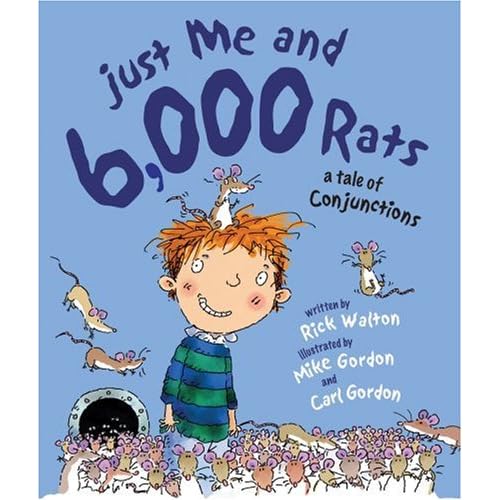
Just Me and 6,000 Rats by Rick Walton
I know I know. It's been too long. But the fall is a busy touring season, and then I was coordinating the Canadian Children's Book Week touring illustrator here on Vancouver Island so I have a pretty good excuse.
I picked up this very funny picture book a while back that I just adore, and if you are a teacher, parent or kid, you will too. It's called Just Me and 6,000 Rats: a tale of conjunctions by Rick Walton, with illustrations by Mike and Carl Gordon. This is one of those totally understated stories where the illustrations belie the text in the funnies of ways. When a kid decides to visit the city, it's no surprise that he wants to do it all: ride the elevator to the top of a skyscraper, visit the museum, and even watch a pro baseball game. Most boys don't bring along rats; especially not 6,000 of them. Hilarious reactions ensue, but along the way, each scene is connected with conjunctions. The utter absurdity of the story allows a little grammar to go a long way. Look for this one today.
Wednesday, November 21, 2007
2007 Information Book Award Announced
The Children’s Literature Roundtables of Canada proudly announces,
THE 2007 INFORMATION BOOK AWARD
WINNER
I Found a Dead Bird: The Kids’ Guide to the Cycle of Life and Death
by Jan Thornhill. Maple Tree Press
HONOUR BOOK
At Vimy Ridge: Canada’s Greatest World War I Victory
by Hugh Brewster. Scholastic Canada
The 2007 Information Book Award prize of $500 will be presented on February 23, 2008, at the Vancouver Children’s Literature Roundtable Serendipity Conference. Accolades and heartiest congratulations to Winner Jan Thornhill (Maple Tree Press) and to Honour Book recipient Hugh Brewster (Scholastic Canada). And… a round of applause for the other exceptional and worthy short-listed authors, illustrators and publishers: Deborah Hodge, John Mantha (illustrator) and Kids Can Press (The Kids Book of Canadian Immigration), Herb Shoveller and Kids Can Press (Ryan and Jimmy and the Well in Africa that Brought Them Together) and Val Ross and Tundra Books (You Can’t Read This: Forbidden Books, Lost Writing, Mistranslations and Codes).
Sincere thanks to everyone who participated in the voting process of this very special award that acknowledges excellence in Canadian non-fiction aimed at informing, inspiring and connecting young readers from coast to coast.
Lois Brymer, National Chair, Information Book Award Committee, jmbrymer@axion.net
Friday, November 16, 2007
2008 Rocky Mountain Book Award short-list announced.
Sunday, November 11, 2007
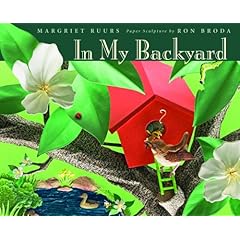
In My Backyard by Magriet Ruurs with paper sculpture illustrations by Ron Broda
With Canadian Children's Book Week coming up, I thought it appropriate to review In My Backyard, written by the Margriet Ruurs and Ron Broda, the illustrator who is touring Vancouver Island where I live. The title says it all in this delightful poetic celebration of nature close to home. "Welcome to my backyard! " Ruurs writes. "You will see that this is a busy place -- all year round." She with words, and Ron Broda with superb paper sculptures, proceed to demonstrate that nature is all around if you simply stop to look and listen. Spare poetic text is perfectly complimented by the rich and textured paper back drops on which Broda builds his multi-layered paper sculptures depicting slow-moving snails, helicoper-like humming birds, and bats catching insects on the wing. A legend at the end of the book supplements the text with more information as well as alerting the reader what to look for on each page. In My Backyard is a must for schools and libraries.
For information on Ron Broda's Victoria appearances, check out the Victoria Children's Literature Roundtable blog.
Wednesday, November 07, 2007
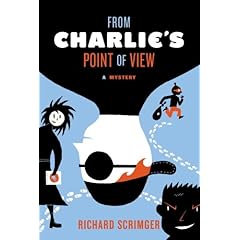
Charlie's Point of View by Richard Scrimger
Having enjoyed Richard Scrimger's The Nose from Jupiter, I recently picked up his recent mystery, From Charlie's Point of View to pass the time on a four hour plane trip to Chicago and wasn't disappointed. Charlie and Bernadette are neighbors as well as friends, but more importantly, they are a team. Bernadette has a less than happy home life, and relies on Charlie for the support she doesn't get at home. Meanwhile, Charlie has loving but over-protective parents, but his blindness leaves him vulnerable. Bernadette willingly takes on the responsibility of being Charlie's eyes and together they manage their respective home lives and the pitfalls of bullies and even dog attacks. A third character, their quirky school mate, Lewis, also suffering from a less than perfect home life, provides comic relief. The mystery comes up when Charlie's father is mistaken for a bank robber. The three kids set out to prove Charlie's father's innocence. Interestingly, an element of mysticisms is thrown into the works with a quasi guardian angel student by the name of Gideon who pops up at opportune moments.
The design of Charlie's Point of View is as ingenious as Scrimger's plot. Black pages mirror Charlie's perspective in addition to the reader's blindness as we follow the kids' path in solving the mystery of who really done it.
Tuesday, October 23, 2007
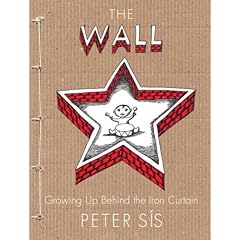
The Wall by Peter Sís
Sometimes a book comes along that sends shivers up and down your spine. The Wall by Peter Sís is one of those books.
It's not a typical picture book that draws the eye with flashes of color. The deceptively simple cover has a homemade look that invites you to open it's pages as if it were a child's school project to merely flip through. And yet, once you crack the cover you are immediately transported by the map to Sis' childhood home in Prague, Czechoslovakia. You enter Peter's world at infancy where he is already clutching the implements of the artist in his fists. This is the beginning of Sís' autobiography told as much in his illustrations and design as it is in text which is drawn from both memory and selections from his journals. They tell the story of his life growing up in Czechoslovakia under Soviet rule. Once children went to school, they were told what to draw and encouraged to report on their families. "He didn't question what he was being told.." Sís tells us until "...he found out there were things he wasn't told." There is gradual shift at this point in the illustration style and layout which mirror's Sís' inner growth. Fluidity, color, and themes begin to shine through, to grow and change until they culminate in a psychedelic Beatle-influenced two page spread in the centre of the book. This reflects a time of growth where everything seems possible to the artist.
Then another change takes place. Suddenly, that hope is quashed and Sís' art art shifts again to a mere line drawing followed by a tribute to "The Scream" explicated by simple text that states, "Russian tanks were everywhere." A glimmer of the artist remains in his dreams which he must keep to himself until eventually, he realizes that sharing his artistic vision is the thing that gives him hope. Since only sanctioned art is allowed, a gorilla art form starts to show up on public walls. Artististic freedom is considered an enormous threat though, and the practice is fraught with danger. The story ends, with the fall of the Berlin Wall, and Sís telling us, that "Sometimes dreams come true."
One of the things most powerful about The Wall is that, although Sis is telling his own story, he chose not to tell it from a first person point of view. In fact, he is telling the story of repression of the artistic if not human spirit as well as his own story. Thus he chooses not to end the story with his own escape from behind the Iron Curtain in 1984, but with the Berlin Wall's fall in 1989. If ever there was a picture book for older readers, this is it. If ever there was a picture book that speaks volumes, this is it. If ever there was a picture book that you should read, THIS IS IT!
A plethora of Readers Choice Awards
Sunday, October 21, 2007
GG's for kids books announced
Children’s Literature English-language Finalists (Text)
Hugh Brewster, Toronto, for Carnation, Lily, Lily, Rose: The Story of a Painting, illustrations by John Singer Sargent
(Kids Can Press; distributed by University of Toronto Press) ISBN: 978-1-55453-137-0
Richly evocative in word and image, Carnation, Lily, Lily, Rose is a fictional account of the creation of a painting, which also tells the larger story of the creative act. As he paints, artist John Singer Sargent is meticulously observed by young Kate, who longs to be immortalized in a great work of art – a beautiful book.
Christopher Paul Curtis, Windsor (ON), for Elijah of Buxton
(Scholastic Canada, distributed by the publisher) ISBN: 978-0-439-93647-7
Elijah Freeman, the first child born of freed slaves in Canada, is the protagonist in this tale which is by turns hilarious and tragic, and always an engaging historical adventure. Christopher Paul Curtis’ creation stands shoulder to shoulder with Mark Twain’s Tom Sawyer and Huckleberry Finn.
Iain Lawrence, Gabriola Island (BC), for Gemini Summer
(Delacorte Press, an imprint of Random House Children’s Books, a division of Random House; distributed by Random House of Canada) ISBN: 978-0-385-73089-1 (trade) / 978-0-385-90111-6 (glb)
John Wilson, Lantzville (BC), for The Alchemist’s Dream
(Key Porter Books; distributed by H. B. Fenn) ISBN: 978-1-55263-934-4
In this engrossing historical adventure, John Wilson paints a vivid picture of a bygone era involving Henry Hudson’s fateful search for the elusive Northwest Passage, an alchemist, mysterious passengers, and enigmatic maps. The Alchemist’s Dream fascinates from start to finish.
Eva Wiseman, Winnipeg, for Kanada
(Tundra Books; distributed by Random House of Canada) ISBN: 978-0-88776-729-6
In Nazi-occupied Europe, fourteen-year-old Jutka dreams of the Canada she has seen in a book, but before her family can flee to safety, the Nazis invade Hungary and Jutka and her family are sent to Auschwitz. There she engages in a daily battle for survival while never relinquishing her dream of one day making it to Canada.
The Jury: Deirdre Kessler (Charlottetown), Pamela Porter (Sidney, BC), Simon Rose (Calgary)
Children’s Literature English-language Finalists (Illustration)
Wallace Edwards, Yarker (ON), for The Painted Circus, text by Wallace Edwards
(Kids Can Press; distributed by University of Toronto Press) ISBN: 978-1-55337-720-7
Wallace Edwards’ The Painted Circus both charms and astonishes with its ingenious, detailed, colourful and excellently rendered picture puzzles. The viewer becomes a participant in the effort to solve the book’s complex mysteries.
Joanne Fitzgerald, Orton (ON), for The Blue Hippopotamus, text by Phoebe Gilman based on a story by Joan Grant
( North Winds Press, an imprint of Scholastic Canada; distributed by Scholastic Canada) ISBN: 978-0-439-95260-6
Joanne Fitzgerald’s beguiling, warmly-toned and decorative series of illustrations perfectly reflects the text, helps it to tell its story, and displays the artist’s painstaking research, as well as her efforts – both in her use of colour and in her choice of detail – to accurately render the ancient setting of this tale.
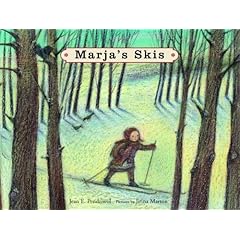
Jirina Marton, Toronto, for Marja’s Skis, text by Jean E. Pendziwol
(Groundwood Books / House of Anansi Press; distributed by HarperCollins Canada) ISBN: 978-0-88899-674-9
Jirina Marton’s vivid, painterly illustrations expertly and touchingly create both of the moods required by the text – the chill, snowy, shadowy exteriors of the winter scenes, and the warm, lamp-lit interiors.
Dušan Petričić, Toronto, for My New Shirt, text by Cary Fagan
(Tundra Books; distributed by Random House of Canada) ISBN: 978-0-88776-715-9 -image not available.
Dušan Petričić’s humorous, dynamic and vividly expressive pictures perfectly complement the text of My New Shirt. The device of arranging the illustrations as a series of snapshots allows the figures to move as in a flip book, and the colour choices – both subdued and vibrant – are an unusual technique for portraying the realistic but comic events of the story.
Duncan Weller, Thunder Bay (ON), for The Boy from the Sun, text by Duncan Weller
(Simply Read Books; distributed by Publishers Group Canada / Raincoast Business Services) ISBN: 978-0894965-33-0-image not available.
Duncan Weller’s The Boy from the Sun, with its striking mix of techniques, lures the unsuspecting reader away from a dark, gloomy and featureless industrial-urban milieu into a brilliantly coloured alternative world of light, colour and hope.
The Jury: Margaret Atwood (Toronto), Michael Martchenko (Toronto), Ludmila Zeman (Montreal)
2007 Canadian Kids Book Awards Announced
The Canadian Children’s Book Centre (CCBC) is thrilled to announce the winners of the four major children’s book awards it administers. The winners were announced last night at a gala event at the Design Exchange in Toronto.
This year’s winning titles follow a young boy who uncovers secrets about his late father after he is sent to live with his grandmother and five female cousins, explore the fascinating aspects of life and death, capture the essence of being a child, and follow a young girl through the horrors of Auschwitz.
. . . .
TD CANADIAN CHILDREN’S LITERATURE AWARD ($20,000)
Sponsored by TD Bank Financial Group
Written by Sarah Ellis of Vancouver, BC
Groundwood Books
“Beautifully written… Ellis is at the top of her game... She skillfully weaves together a story within a story and creates a place for the reader… I re-read this book as soon as I finished… A brilliant ending.”
Jury members: Merle Harris, author and storyteller; Theo Heras, Children’s Literature Resource Collection Specialist, Lillian H. Smith Library, Toronto Public Library; Dr. Dave Jenkinson, professor, Faculty of Education, University of Manitoba; Norene Smiley, author; and Maya Munro Byers, owner, Livres Babar Books, Montreal.
. . . .
NORMA FLECK AWARD FOR CANADIAN CHILDREN’S NON-FICTION ($10,000)
Sponsored by the Fleck Family Foundation
Written by Jan Thornhill of Havelock, ON
Maple Tree Press
“Exceptional, original and engaging… The topics covered in this book are so powerful and so unusually fascinating… If you had to pick one way to explain our struggle with life and death this book would be it.”
JURY MEMBERS: Mary Anne Cree, Junior School Librarian, The Bishop Strachan School; Polly Fleck, Governor General’s Award-nominated poet and member of the Fleck family; Frieda Wishinsky, author; Sheila Koffman, owner, Another Story Bookshop, Toronto; and Todd Kyle, branch manager, Churchill Meadows Library, Mississauga Library System.
. . . .
MARILYN BAILLIE PICTURE BOOK AWARD ($10,000)
Sponsored by A. Charles Baillie
Written by Sara O'Leary of Hamstead, QC
Illustrated by Julie Morstad of Vancouver, BC
Simply Read Books
“Beautifully illustrated and timeless… O’Leary takes the reader on a whimsical tour of the imagination and captures the essence of what it is like to be a child... Simply amazing!”
JURY MEMBERS: Jeffrey Canton, Faculty of Arts, York University and children’s book reviewer; Myra Junyk, literacy advocate and author; and Janis Nostbakken, writer, producer, broadcaster and founding editor of ChickaDEE magazine.
. . . .
GEOFFREY BILSON AWARD FOR HISTORICAL FICTION FOR YOUNG PEOPLE ($1,000)
Sponsored by the Canadian Children’s Book Centre’s Bilson Endowment Fund
Written by Eva Wiseman of Winnipeg, MB
Tundra Books
“A poignant story that depicts the horrors of life inside the German concentration camps and the prejudice and persecution which the Jewish people experienced… Wiseman’s writing style is captivating and young people will be easily swept into the story.”
JURY MEMBERS: Albert Fowler, author and storyteller; Sharon McKay, author; Vicki Pennell, editor of Resource Links and IMPACT; and Gail de Vos (chair), storyteller and professor, School of Library and Information Studies, University of Alberta.
. . . .
These books exemplify some of the best work by Canadian authors and illustrators. The Canadian Children’s Book Centre is proud to share these titles with you. For a complete shortlist for each award, please visit www.bookcentre.ca.
. . . .
ABOUT THE TD CANADIAN CHILDREN’S LITERATURE AWARD
The TD Canadian Children’s Literature Award was established in 2005 to honour the most distinguished book of the year for children aged 1 to 13. Entries are judged on the quality of the text and illustrations and the book’s overall contribution to literature. All books for children, in any genre, written by a Canadian, are eligible for the award. The winning book receives $20,000 and there is $10,000 to divide amongst the honour books. The publisher of the winning book receives $2,500 for promotional purposes.
ABOUT THE NORMA FLECK AWARD FOR CANADIAN CHILDREN’S NON-FICTION
The Norma Fleck Award for Canadian Children’s Non-Fiction was established by the Fleck Family Foundation in 1999 to recognize Canada’s exceptional non-fiction books for young people. The award honours Norma Fleck (1906 – 1998), who inspired a deep love of reading in her children and grandchildren. The winning book receives $10,000.
ABOUT THE MARILYN BAILLIE PICTURE BOOK AWARD
The Marilyn Baillie Picture Book Award honours excellence in the illustrated picture book format, for children aged 3 to 6. Charles Baillie, retired Chairman and CEO of the TD Bank Financial Group, is delighted to give the prize in his wife Marilyn’s name. As an award-winning children’s book author and an early learning specialist, Marilyn is involved in and passionate about children’s literature. The winning book receives $10,000.
ABOUT THE GEOFFREY BILSON AWARD FOR HISTORICAL FICTION FOR YOUNG PEOPLE
The Geoffrey Bilson Award was established in 1988 in memory of the respected historian and children's author, Geoffrey Bilson. The $1,000 prize is awarded annually to the Canadian author of an outstanding work of historical fiction for young people. In 2005, an endowment fund was created to support this award. If you wish to contribute to this fund, please contact the CCBC.
ABOUT THE CANADIAN CHILDREN’S BOOK CENTRE
The Canadian Children’s Book Centre is a national, not-for-profit organization and registered charity founded in 1976 to promote, support and encourage the reading, writing and illustrating of Canadian books for children and teens. With book collections and extensive resources in five cities across Canada, the CCBC is a treasure-trove for anyone interested in Canadian books for young readers. For more information, please visit www.bookcentre.ca.
Friday, October 19, 2007
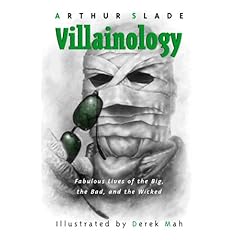
Villianology by Art Slade
Ok, I've just been to Art Slade's website and you have to check out the trailer for his new book, Villianology: Fabulous Lives of the Big, the Bad and the Wicked. I admit that I haven't read it yet, but if it's anything like Monsterology: Fabulous Lives of the Revolting, and the Undead, you won't be disappointed. Then again, I admit that I'm a big Slade fan in general. I loved Tribes and read Dust in one sitting; I couldn't put it down!
Thursday, October 18, 2007
The 2007 Moonbeam Awards
Butler Book Prize
Wednesday, October 17, 2007
Book Bites for Kids
Sunday, October 14, 2007
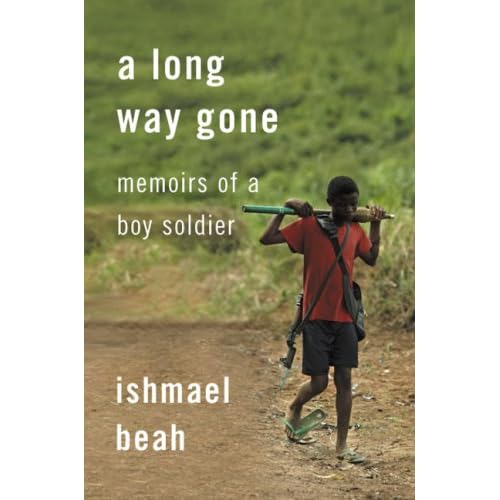
A Long Way Gone: memoirs of a boy soldier by Ishmael Beah
I will continue to post picture book and juvenile book reviews and news here.
We read A Long Way Gone: Memoirs of a boy soldier by Ismael Beah for my book group last month, and I was blown away. There is no pretension in this moving but disturbing real life story of the devastation and dehumanization of war on children's lives.
Now a child-rights advocate, Ismael Beah tells his own story of a childhood lost to war and destruction. It is as gripping as it is horrific. I'd say it's a must read adults and teens alike, but some might find it just too difficult. The story begins in Ishmael's small village in Sierra Leone when he is twelve. It ends after a grueling three years of war, followed by a difficult rehabilitation and finally a trip to the UN in New York as a child representative. It is a lonely and painful journey, one where trust is lost to fear and the ravages of war. It is a journey that you would not wish on your worst enemy much less a child.
Not unlike kids of the same age in Western Countries, Ishmael's world is about friends and music, with the safety net of family hovering in the background. This is where Ismael's story begins. Of course there are differences. Ismael and his brother and his friends (who are in a rap group) must walk to the next village sixteen miles away to perform whereas our kids can catch a ride with parents or take the bus. But, Ismael's innocence and carefree life ends suddenly when mutilated messengers stagger into the neighboring village where they have gone to perform. The news they bring is devastating. The boys home village has been torched and their families murdered. Worse still, the rebels are on their way. The boys scatter into the jungle along with the other villagers. Their new life becomes one of hunger and fear and endlessly putting one foot in front of the other with no real place to go to. The brutality of the civil war breeds fear and distrust even of children since both the rebels and the government kidnap children and turn them into drugged killing machines. After months aimless wandering, Ismael is taken by the government forces and turned into a child soldier as addicted to killing as he is cocaine. It is frightening to read about how a precocious twelve year old who loves music and pranks can be turned into a killer without a trace of remorse.
It isn't until Ismael has spent three years as a soldier that the UN plucks he and several other boys like him out of the army and into a rehabilitation centre. Although you might imagine this to be a welcome change, the child soldiers do not. By then, Ishmael, and others like him no longer think of themselves as children at all. Their AK-47's and killing, not age defines who are are. It is their means of survival and their power and place in the world. The psychological impact of taking their guns is even more difficult to endure than their withdrawal from the drugs that have helped to numb their humanity. The question of whether or not these children's psyches have been destroyed is an all too real one. However, the staff at the rehab centre persists and little by little, Ismael and the others begin to open up, to grieve, and to heal. In Ismael's case, is what helps to heal him.
Still, A Long Way Gone is a difficult road to walk as a mere reader. And it is equally difficult to grasp how this young man walked it real life. The fact that he has survived, that he has written this book and that he continues to speak out against war, is a testament to the human spirit. You won't read a more disheartening and nor a more uplifting story. Read it.
Monday, October 08, 2007
I have a new separate Teen Reads Blog
Thursday, October 04, 2007
A Perfect Gentle Knight by Kit Pearson
I finished Kit Pearson’s A Perfect Gentle Knight a week ago, but haven’t been able to get Corrie, the story’s eleven-year-old narrator, or her perfect gentle knight of a brother Sebastian out of my mind. They are so achingly real that it’s hard to let them go.
Set in Vancouver in the 50’s, the Bell family is both ordinary and extraordinary. Two years after the death of their mother, the six children have learned to rely on each other since their grief stricken father has thrown himself into work. Sebastian, the oldest, tenuously holds his ragtag siblings together partly through a game involving the Knights of the Roundtable. The lines between fantasy and reality begin to blur for Sebastian when he truly imagines that he is the reincarnation of Sir Lancelot. As Sebastian slips deeper into fantasy, Roz, the next oldest is increasingly saddled with parental responsibilities. Torn between family and the desire to be popular, twirl baton, and have dance parties like her peers, Roz downloads to Corrie. The middle child, Corrie does her best, but she is equally torn between a new best friend and trying to juggle the needs of her younger siblings and her father.
This might read as mere melodrama in the hands of a less skilled author. However, this is where Pearson shines. The picture she paints is so rich in historical and geographical details that they anchor the Bell children, their passions, insecurities and foibles. It’s easy to get caught up in Corrie’s life, and it is equally easy to see why the Bell children’s Arthurian fantasy is both a refuge and a trap. As Sebastian’s grip on reality slips, Corrie slides closer to that place where childhood and maturity collide. It is a tough place to be in and tougher place to write about. And yet, Pearson manages it all in such a perfect gentle way.
Wednesday, October 03, 2007
Review of A Perfect Gentle Knight by Kit Pearson is coming soon
Ok, so I had every intention of reviewing Kit Pearson's new book, A Perfect Gentle Knight this evening, but instead I'm going out to see a troop of Maori dancers/singers. It is going to be sooo cool. It's happening at the Esquimalt Long House shortly, so gotta run. But, I will get to this wonderful read tomorrow. Promise.